Fountain of Sorrow

On the train back from Baltimore the other day, I decided to start editing a bunch of old family photos. I clicked on the tiny icons, not knowing what each picture was until I opened it. There was my grandmother’s cousin George, who just died this summer at age 90, in his Navy uniform from World War II. There was my mother’s Uncle Andy in what looks like a World War I cavalry uniform, complete with riding crop. There were Mom, my siblings, and me on the beach, circa 1967.

It’s good to see your smiling face tonight.
I was jolted by this family photo, with my father on the right. “It’s good to see your smiling face tonight.”

And then, unexpectedly, a much more recent shot: Mom and Dad, gray-haired, standing with Mom’s cousin Peggy, Peggy’s husband, and Mom’s sister. The three women all have their heads tilted in laughter. The men are looking at the camera, also laughing.

I was jolted by this image of my father—alive and happy, his hands on my mother’s shoulders, enjoying himself. Looking not too different from the last time I saw him. My eyes filled with tears. Sometimes the grief still comes without warning, the way his death did three years ago.

Continue reading

In ___ We Trust

As a child in a devout and open-minded Catholic family, I believed in God as I believed in my parents: unquestioningly.

At age 18, I suffered a crisis of faith. I had been taught in church that there was an Old Testament God—wrathful, vengeful, violent—and a New Testament God, the one we followed, who was generous, forgiving, and endlessly loving. Lacking sophistication and spiritual guidance, I couldn’t square these ideas with my belief that there is only one God. If the Old Testament/New Testament split is at the heart of Christianity, I decided, I could no longer consider myself Christian. It was an agonizing conclusion. But I still believed in God, unquestioningly.

Some 15 years later, when I decided to become Jewish, the beit din (rabbinic court) asked me about my observance of the Sabbath and dietary laws. They asked about the upcoming holiday of Shavuot. They asked what I thought about Jesus. (My reply: I don’t think about him very much.) If the rabbis had asked whether I believed in God, I would have said yes. But they didn’t. After the beit din, I went to the mikveh and emerged as a Jew, my faith in God still unquestioned.

Continue reading

My six-week perfectionism detox (and its imperfect outcome)

I’m six weeks into the Mary Oliver Challenge. How’s it going?

I’ve been away a lot. The challenge of being myself, of believing that I am good enough—with all of my shortcomings, needs, and desires—goes with me wherever I go. But it’s strongest when I’m at home. That’s when everyone else is carrying out their normal lives of work and family responsibilities, while I live in this artificially self-centric world I have created.

In Mary Oliver’s poetic words, the challenge is to let the soft animal of my body love what it loves. So the very first step is to persuade myself that the challenge itself is a good idea: that taking time off to work toward self-acceptance is is neither selfish and hedonistic, on the one hand, nor self-destructive on the other.

I’m still working on that first step.

Continue reading

6 nightmares of highly effective people

Nightmare 1: You waste time. A lot of time.

Nightmare 2: You tell yourself it’s okay to make mistakes as long as you learn from them. You make mistakes. You don’t necessarily learn from them.

Nightmare 3: You stay up ridiculously late on Ancestry.com, even though you have not fully recovered from a two-day period of unexpected and unsettling fatigue.

Nightmare 4: Despite #3, you start the day with energy and motivation for some needed house cleaning. But then you spend your time on Ancestry.com and solitaire instead.

Nightmare 5: You have all the time in the world to do things you love—reading novels, walking in the woods, personal writing, family history research—and to catch up on projects you’ve been wanting to get done. You do a bit of those things, but spend a mind-numbing amount of time playing solitaire and perusing Facebook.

Nightmare 6: You have all this time because you quit your job with the goal of learning how to “just be.” Your sense of self depends too much on what you are able to get done, so you set the goal of doing only what you feel like. When a friend says he would flounder without structure in his days, you can only nod and try to explain the seeming paradox: you have deliberately created a situation in which you often feel that you are undermining yourself. Unsurprisingly, your friend is confused by this decision.

In the past five days, I have lived all of these nightmares. I call them that because they’re the opposite of what you expect from responsible, highly effective people, those with oodles of self-discipline and excellent habits that help them get where they want to be in life. Sometime in my 30s or 40s, I finally stopped having the forgot-my-gym-clothes-can’t-find-my-locker-don’t-know-the-combination-lost-my-class-schedule-can’t-find-the-classroom dreams that had followed me since junior high school. These are the new version.

Continue reading

Unearned blessings

A few mornings ago, as I wandered around my backyard draped in my tallit (prayer shawl) and tefillin (don’t ask), I felt the urge to finish up my prayers so that I could get on with what I’m supposed to do.

That outlook was bad enough when I had a schedule to keep. Prayer is what I’m supposed to do, I would remind myself. It’s the way I’ve chosen to start my day. It’s not something to get out of the way so I can commence with the real stuff.

Now that I have quit my job and am not “supposed to” do anything, my impatience is just plain ridiculous. But the other day, the thought struck me from a different direction: I feel the need to finish counting my blessings so that I can start earning them.

Continue reading

Feet first

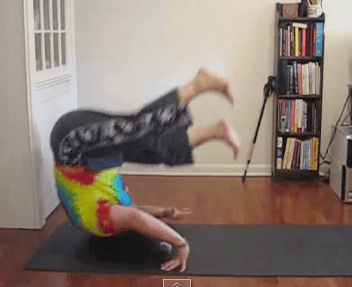
In yoga class today, I tried to do a handstand.

No. I tried the thing you were supposed to do if you couldn’t manage a handstand. Then I tried the thing for people who can’t manage the substitute.

I couldn’t do any of them. But I tried a few times, attempting to push away the thoughts about how ridiculous I looked. When the disabled war veteran keeps falling in that inspirational yoga video, it’s … inspiring. When I do it, not so much.

“Never Give Up,” the video caption says.

At this moment in my life, that’s a complicated message. I’m trying to break my dependency on measurable goals and achievements. I’m trying to accept myself in my current, unimproved state. If “Never Give Up” means “Never Be Satisfied With Where You Are In Life,” then it is the wrong slogan for me.

But I do have goals. One goal is to try things out, even when I’m afraid of them. (Like this whole blog, and the Mary Oliver Challenge itself.)

A related goal is not to stop trying just because the first attempt fails. So in class today, when I put my hands on the floor and my feet against the wall and they slid right back down, I tried again, and again, and again.

It didn’t get easier. I didn’t see any improvement. I may never achieve a handstand, and I’m not setting that goal. But if I’m in a class where handstands are on the agenda, I’ll give it another shot. I might give up on specific goals. But I won’t give up on myself.

What is the Mary Oliver Challenge? Glad you asked! You can read about it here.

Lost and found

“You don’t have to find yourself,” says the sign at the yoga studio. “You have to create yourself.” But I think I do need to find myself.

That’s not to pick a fight with the sign at the yoga studio. There is no ready-made, off-the-shelf self waiting to be discovered, like the perfect wild raspberry hidden along the trail. Finding myself is not a matter of practicing the right asanas, chanting the correct prayers, or following the proper program. It will take a lot of creative effort. So maybe we’re on the same page, the yoga-studio sign and I.

Still, “finding” is a central part of what I need to do. When I lost my father, I lost a part of myself. Three years later, I’m still not sure what that part is, let alone how to find it.

Continue reading

From Badlands to The Promised Land

I used to have a workout playlist that started with Bruce Springsteen’s “Badlands” and ended with his “The Promised Land.” Great tunes, driving rhythms, uplifting theme — what better way to start strong and finish strong?

A technical glitch zapped that playlist, along with the rest of the music on my iPod. Some life glitches zapped my workouts, and the Humpty Dumpty playlist is one of the things I have not yet put back together again.

But I’ve been thinking lately about the Badlands-to-Promised Land trajectory and how it so perfectly fits our culture, with its stories of true grit and triumph over adversity. It perfectly fits the trajectory I was trying to follow in my life: the better-stronger-higher-deeper ethos that not only pervades popular culture, but also motivates some of the people I most admire.

It’s a great story line for getting me off my tuchus to exercise. But as a life story, it leaves a lot to be desired.

Continue reading

Blitzing the list: why Getting Stuff Done does not get the job done

Today is the first full-fledged day of the Mary Oliver Challenge, and it is a challenge. My soft animal is feeling the sharp, pointy teeth and claws of anxiety. The challenge is to grapple with that feeling instead of letting it take over or pushing it into a corner where it will lurk, glaring at me and waiting to pounce again.

My last day of work was Tuesday. Wednesday, we left for vacation. Last night, after we returned, I immediately began to feel the pressure of Getting Stuff Done. I unpacked from our trip and started the laundry. Then I set aside time to write in my journal. There was so much else to Get Done: emails, household chores, putting away the stuff I brought home from work and dumped on my dresser last week. Plus things I wanted to do, including writing a blog post and responding to friends who gave me such kind, supportive feedback on the first post. (If you are one of those friends: thank you! I haven’t forgotten you.)

But I reminded myself: there will always be Stuff To Do. I have to learn to live with that. And I made two resolutions for the next day: I would not stress out over chores, and I would not stress out over whether to go to the $5 yoga class that meets downtown on Mondays.

Continue reading

What is the Mary Oliver Challenge?

For this year’s Passover seder, my daughter brought a packet of poems that she related to the themes of the holiday. One of those poems, Mary Oliver’s “Wild Geese,” grabbed hold of my imagination and would not let go.

Throughout the spring, I returned to the poem again and again. It seemed to offer a glimpse of what freedom and redemption could really feel like — a vision that I find both tantalizing and terrifying.

You do not have to be good.

What?! Of course I have to be good.

You do not have to walk on your knees
For a hundred miles through the desert, repenting.

Hmmm. I do have to trek through the desert, or at least through the wilderness. For the past three years, since my father died, I have been struggling through the rugged terrain of my own psyche: the barren deserts, the forbidding forests, the mountains that I have to either climb, hand over hand, or tunnel beneath. Occasionally there’s an oasis, a clearing, a breathtaking waterfall or a heartbreakingly beautiful rainbow. But overall, it’s been an arduous trek, and one that I make by necessity, because my father’s death shattered the psychological place where I used to live. That world, and the person I used to be, no longer exist.

So I do have to walk through the desert, but I don’t have to walk on my knees. I don’t have to make my journey more strenuous for the sake of penitence and self-correction. I don’t have to — but that’s what I do. Could I really free myself from that self-imposed servitude?

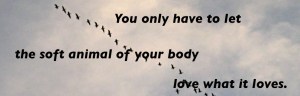
You only have to let the soft animal of your body
love what it loves.

This is the refrain I keep coming back to: I only have to let the soft animal of my body love what it loves. That’s all? That’s harder than the first two, harder than anything.

It sounds so appealing, so cozy, like a kitten cuddling in your lap or a dog snoozing gently in the sun. Soft, warm, relaxed, loving what you love, not thinking about anything else.

But what if my soft animal is too soft — too lazy, self-indulgent, self-centered? What if I don’t want to do anything else but lie in the sun? Or what if that animal turns out to be not a docile pet, but a wild animal: aggressive, ruthless, tearing apart the people and the life I love?

Throughout the spring, I struggled to explain to family and friends why I was so struck by this poem, and so stuck on it. I struggled to explain what the soft animal represents, why the notion of letting it love what it loves was so alluring and yet so frightening.

“What does it mean to you?” my therapist asked (one of her favorite questions). Then she nailed it: “It means being yourself.”

That’s exactly right. Letting my soft animal love what it loves means being myself. I do not have to be good all the time. I do not have to walk on my knees. But I do have to find the courage to let other people see me as I really am. And I have to discover for myself who I really am — including the parts I have worked hardest to disguise and ignore.

For 30 years, I did my best to ignore the nagging feeling that I am not good enough. At anything. Ever. In every area of my life that mattered to me, personally and professionally, I fell short of my own expectations. As a spouse and a parent, a daughter and a sibling, a friend and a neighbor: not good enough. My work: not good enough. Physically: not fit enough. Intellectually: not educated enough. Whatever I set out to do, I felt that I should do it better and more.

For years, I submerged these feelings beneath activities designed to make me feel “good enough.” If I pushed myself just a little bit harder, maybe my accomplishments would compensate for my gaping flaws, or at least cover them up. The strategy was partly successful — until my father’s sudden death. Then, I found myself overwhelmed by shock, grief, and this not-good-enough feeling that I could no longer avoid. In the language of the Passover story, this is my Egypt, my land of captivity.

So I’m working to let these feelings surface, to face them head-on, and to find a way through them — through the desert — to the Promised Land of self-acceptance. My father, of blessed memory, was one of the very few people I know who truly, genuinely felt good about himself. He didn’t think he was better than other people. But he thought he was good enough. What better memorial could I establish than to find that same inner peace?

And so was born the idea of the Mary Oliver Challenge: a commitment to letting the soft animal of my body love what it loves. A commitment to figuring out what I want, untangling it from what I think I should want and should do.

I hadn’t been excited about my job in a while. The horizon was distinctly lacking in exciting prospects. But when my incredibly supportive husband suggested that I take some time off, I rejected the idea. I need structure, I told him. I would set wonderful, self-nurturing goals (Go to yoga class every day! Explore my family history! Get back in shape!), fail to accomplish them, and feel worse than ever, I told him.

Then I thought: what if my goal was not to set goals? What if my plan was not to make plans? I might want to do those things eventually. But at the outset, what if I just try to do what I want? Try to discover what I want and how to pursue it even when it scares me, even when my reach exceeds my grasp? What if I accept that this challenge will necessarily involve wasting time — time when I want to be writing a blog post or an essay, or restarting my running practice, but when instead I distract myself from that intensity and my fear of failure by playing solitaire or poking around Facebook? What if I accept that inevitability as part of the process rather than considering it a failure?

I started writing this post in May. It’s now the end of June. I spent most of that time not working on it at all, and the rest tinkering with the few sentences I had already written. Like Penelope in The Odyssey, weaving and unweaving the same piece of fabric, I hoped to postpone the moment of completion and its accompanying moment of decision: do I want to hit “publish” and hang my linens out for the world to see?

I am determined not to let this blog become a “should,” so it might end up as the world’s shortest-lived project. But at this moment, the answer is “yes.”

Wild Geese
You do not have to be good.
You do not have to walk on your knees
For a hundred miles through the desert, repenting.
You only have to let the soft animal of your body
love what it loves.
Tell me about your despair, yours, and I will tell you mine.
Meanwhile the world goes on.
Meanwhile the sun and the clear pebbles of the rain
are moving across the landscapes,
over the prairies and the deep trees,
the mountains and the rivers.
Meanwhile the wild geese, high in the clean blue air,
are heading home again.
Whoever you are, no matter how lonely,
the world offers itself to your imagination,
calls to you like the wild geese, harsh and exciting —
over and over announcing your place
in the family of things.

* Mary Oliver does not endorse this blog, which she has probably never heard of.